

Tanabata — Story of Two Star-crossed Lovers

市中繁栄七夕祭 by Hiroshige
Today is a special day all over Japan where people celebrate Tanabata, the Star Festival. Tanabata is celebrated to commemorate the romantic story of two lovers represented by the stars Vega and Altair who are only allowed to meet each other once a year as long as the skies are clear. It is celebrated on the 7th day of the 7th lunar month, which is July 7th in the modern calendar. Some places in Japan celebrate Tanabata on August 7th in accordance with the older Chinese calendar, which is where the legend originated. The most famous of all the Tanabata festivals is celebrated in Sendai on August 7th, but most of Japan recognizes Tanabata today (July 7th).

Tanabata Festival in Edo (Hiroshige, 1852)
On Tanabata, people write wishes on small pieces of colored paper called tanzaku and hang them on bamboo trees. These become beautiful wish trees. On the following day, the decorated trees are floated on a river or in the ocean and burned as an offering. There are many celebrations all over Japan, which also include parades, food stalls, colorful decorations, and fireworks.
Tanabata originated from a Chinese legend called Qixi and was brought to Japan in the 8th century. This is the story of two lovers. Princess Orihime, the seamstress, wove beautiful clothes by the heavenly river, represented by the Milky Way. Because Orihime worked so hard weaving beautiful clothes, she became sad and despaired of ever finding love. Her father, who was a God of the heavens, loved her dearly and arranged for her to meet Hikoboshi, the cow herder who lived on the other side of the Milky Way. The two fell in love instantly and married. Their love and devotion was so deep that Orihime stopped weaving and Hikoboshi allowed his cows to wander the heavens.

Orihime’s father became angry and forbade the lovers to be together, but Orihime pleaded with him to allow them to stay. He loved his daughter, so he decreed that the two star-crossed lovers could meet once a year--on the 7th day of the 7th month if Orihime returned to her weaving. On the first day they were to be reunited, they found the river (Milky Way) to be too difficult to cross. Orihime became so despondent that a flock of magpies came and made a bridge for her. It is said that if it rains on Tanabata, the magpies will not come, and the two lovers must wait another year to be reunited, so Japanese always wish for good weather on Tanabata. There are many variations of this story, but this version is the most widely held.
We hope for clear skies on Tanabata so the lovers can always be reunited.
Objects for Seasonal Gatherings
Seasonal festivals like Tanabata are deeply connected to Japanese craft traditions. Objects used in daily life — from glassware to ceramics — often reflect nature, stars, and seasonal symbolism.


These exquisite Kyo-Saga bamboo chopsticks are meticulously handcrafted from premium bamboo varieties—white bamboo, goma bamboo, mon bamboo, and smoked bamboo—each chosen for its unique look. Carefully nurtured and dried over years, the thick-walled bamboo is expertly carved to create a chopstick that fits comfortably in hand and provides a natural, effortless grip.
Designed with fine, square tips, these chopsticks offer exceptional precision, making it easy to pick up even small grains or delicate foods. Their refined craftsmanship and natural beauty make them a timeless addition to any dining experience, honoring the artistry of Japanese bamboo craftsmanship.
from left,
Smoke TB03 $25
White TB04 $20
Mon TB02 $22
Sesame TB01 $20
24cm L
Stand not included.
Gift box available for $2 each.
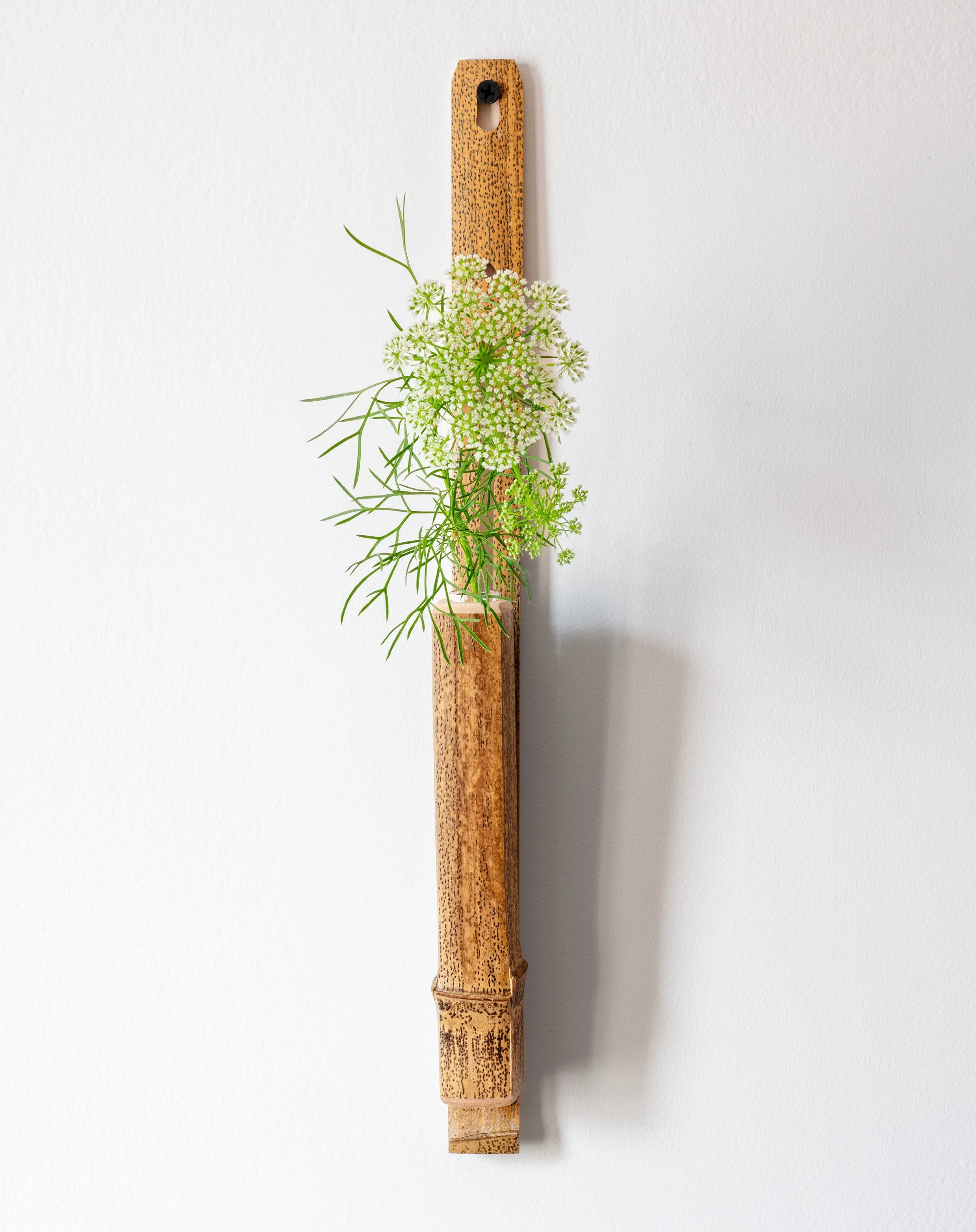
This minimalist flower vase set by Takano Bamboo includes the Ichirinzashi vase and the Jizai hanger, both handcrafted in Kyoto from Gomatake bamboo and cherry wood. Designed to hang elegantly on a wall, it holds a single stem—an expression of restraint that invites quiet attention to the fleeting beauty of nature.
The Jizai hanger features a simple, adjustable mechanism that allows you to change the height at which the vase is suspended, offering flexibility for different spaces and arrangements.
In Japanese culture, bamboo has long symbolized strength, flexibility, and renewal. It grows quickly without chemicals, regenerates from its roots, and requires little water—making it not only beautiful, but also one of the most sustainable natural materials. The craftspeople at Takano Bamboo have refined their techniques over generations, creating pieces meant to be used, repaired, and passed down.
The simplicity of this set is not only aesthetic—it reflects a philosophy of living with less, but better. Perfect for tea rooms, entryways, or any space that values the quiet presence of nature.
These are all made by hand, so each one may differ from the photo and listed measurements. Nails are not included.
Material: Bamboo, Cherry & Glass
Vase: Approx. 160mm H x 24mm D (6.3" H x 0.94" D)
Hanger: Approx. 368mm H x 25mm D (14.5" H x 1" D)
TB15

Horiguchi Kiriko and Shotoku Glass, two esteemed glassmakers with deep-rooted histories, have collaborated to create the Kai series—an expression of Edo Kiriko artistry blended with contemporary elegance.
Each glass is hand-blown by Shotoku Glass artisans, then meticulously cut by Horiguchi Kiriko craftsmen. The Kakudashi pattern features precisely carved facets, creating a striking interplay between polished brilliance and matte surfaces, an effect that enhances the depth and complexity of the design.
A refined yet functional piece, the Kai Kakudashi Glass is perfect for those who appreciate fine craftsmanship. Collect all three designs to explore the beauty of Edo Kiriko’s varied expressions. It also makes a distinguished gift, presented in an elegant kiribako wooden box.
Approx. 78mm D x 78mm H (3.1" D x 3.1" H)
HK04
These are all made by hand, so each one may differ from the photo and listed measurements.
This post is part of our ongoing series on Japanese Seasonal Rituals, exploring how traditions like Oshōgatsu, year-end celebrations, Setsubun, cherry blossom season and Tanabata quietly mark the passage of time throughout the year.